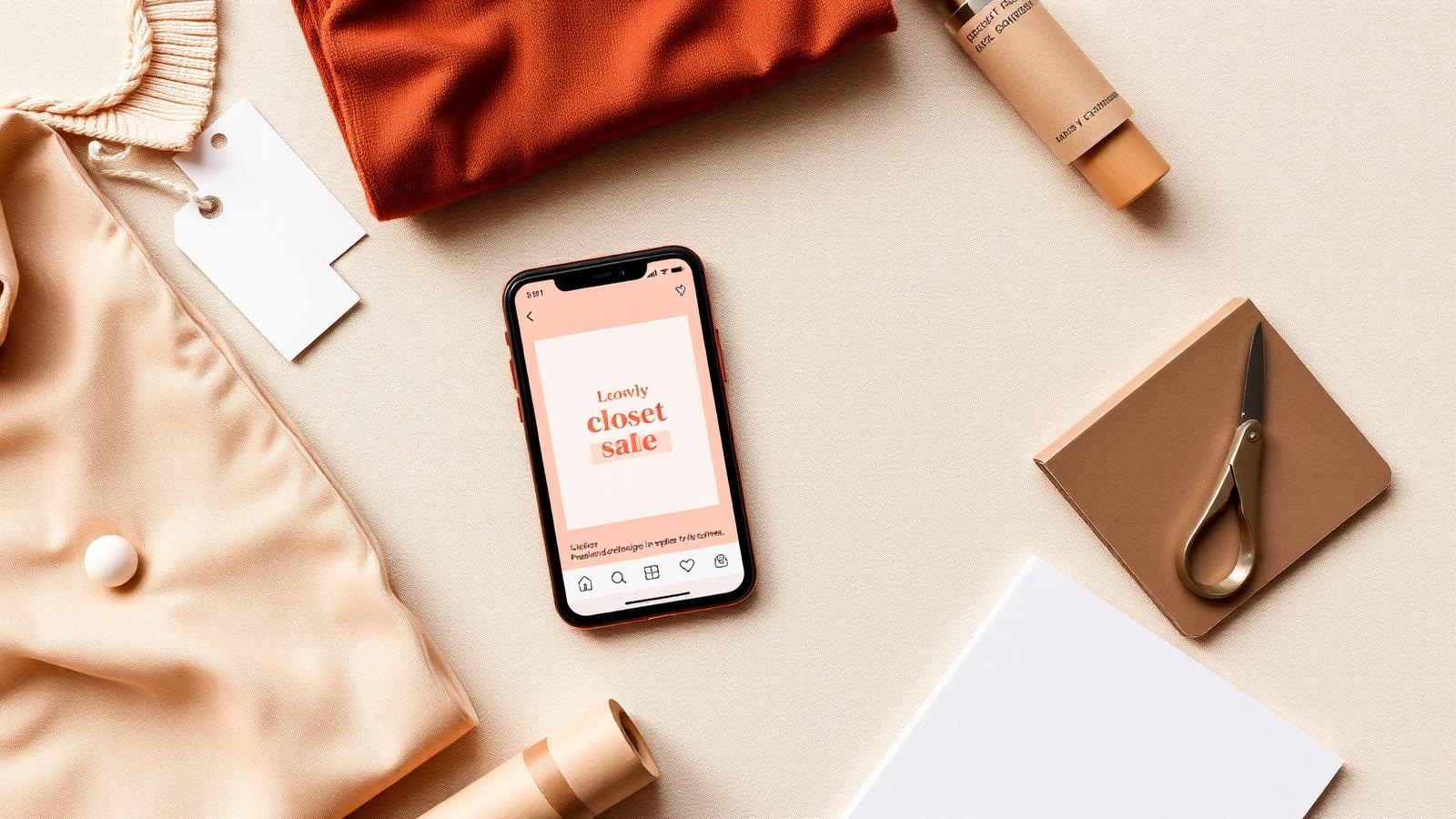
An Instagram closet sale is one of the fastest ways to clear a wardrobe, fund the next season of buying, and quietly turn followers into buyers. The format has not changed much in years — Stories, a sale account, a 24-hour drop — but the way you run it in 2026 has. Buyers expect a real listing, not a comment thread. Payments expect a paper trail. And your inbox cannot be the storefront.
This guide walks through how to run an Instagram closet sale start to finish: the account, the photos, the pricing, the drop, the orders, the shipping day, and how to make the next sale easier than the last.
Turn this guide into your next drop.
1. Set up the sale account (and the one link)
Most creators run their closet sale from a dedicated sale handle — something like @shop.yourname or @yourname.closet. It keeps your main feed clean, gives buyers a single place to follow for future drops, and makes the sale legible to anyone landing cold.
Set the bio up like a tiny storefront. Buyers should know in five seconds what they are looking at, how to buy, and where to go.
- What the account is (closet sale, sizes carried, vibe).
- How the sale works (drop day, claim flow, payment, shipping).
- Where to shop — the link in bio should go to one closet page, not a homepage.
- Any limits — country shipped to, local pickup only, no returns, etc.
The single biggest upgrade since 2019: the link in bio is no longer optional. A Loovly closet works as that one link — it shows every available piece with size, condition, price, save, follow and request, and stays live well beyond the 24-hour Story window. Send every Story arrow and every caption to that one URL.
2. Curate and shoot the pieces in one session
A focused edit of 20–40 pieces almost always outperforms 200 mid pieces, both for revenue and for how the closet reads. Pull anything that has not been worn in six months but is still in great shape, mistake buys, vintage finds you have outgrown, and brand-gifted pieces you are allowed to resell.
Then batch the whole sale into one short shoot day. One backdrop, one light source, one outfit-on-body setup. The visual consistency is what makes the closet feel like a collection rather than a pile.
Shoot checklist
- Steam or iron every piece — wrinkled clothes look 30% cheaper.
- Shoot in daylight near a window or with a single soft light.
- Keep the background plain: a wall, a sheet, a wooden floor.
- Use the same crop, distance and angle for every shot.
- Photograph any flaw close-up — honesty saves returns and builds trust.
If you list on Loovly alongside the Instagram drop, the AI-assisted listing flow can turn each photo into a draft title, description, category and size hint — 30 items stops feeling like 30 separate captions to write.
3. Price like a buyer
The biggest pricing mistake is anchoring to original retail. Your buyer is comparing to Vinted, Depop, Vestiaire and the wider resale market — not to the price tag from three years ago. Price the piece for how it sells today.
| Condition | Suggested resale range | Why |
|---|---|---|
| New with tags | 40–60% of retail | You still need to beat full-price resale options. |
| Worn once or twice | 30–45% of retail | Looks new, but no longer carries the new tax. |
| Gently used | 20–35% of retail | Honest middle ground — moves fast with a good photo. |
| Well-loved | 10–25% of retail | Bundle these or use them as add-ons. |
| Vintage or rare | Price by demand | Forget retail — let buyer interest set the floor. |
Round to clean numbers. Offer a small discount for two or more pieces. If a piece does not move in the first week, drop the price publicly and post about it — the price drop becomes its own moment of content.
4. Build the drop as a 7-day campaign
You do not need a huge audience to make a closet sale work. You need a clear timeline. The same 7-day rhythm works whether you have 800 followers or 80,000.
- Day 1: Announce the date, theme and where the sale will live.
- Day 3: Teaser — three hero pieces in a flat-lay or try-on Reel.
- Day 5: Behind-the-scenes Story of you photographing the closet.
- Day 7: Drop — Stories + grid post + one Reel + link-in-bio update.
- Day 8–10: Restock posts, public price drops, last-pieces Stories.
Slide design that actually sells
Use a free template tool (Unfold, Canva, Mojo) and keep every slide consistent so the sale reads as a series. Open with a How It Works slide, then one slide per piece.
- Brand and item name.
- Size, fit notes, condition (including any honest flaws).
- Price in your main currency.
- A clean front photo plus a styled or on-body shot.
- A clear tap arrow pointing to the closet link.
Save every slide to a Highlight called Closet Sale so anyone who finds you mid-week can still browse. When a piece sells, mark it sold on the slide instead of deleting it — sold-out energy creates urgency for the rest.
Turn this guide into your next drop.
5. Take orders without losing your weekend
This is where most Instagram closet sales fall apart. By the third Story slide, the DMs become a graveyard of "is this available?" messages, payment screenshots, address typos and lost orders. The fix is structural: one place to claim, one place to pay, one place to confirm shipping.
Claims
Let buyers claim a piece through a request or interest form on the listing, not through Story replies. Reserve the piece for a 12–24 hour window for the first claimant. If they do not confirm, move down the wait list. State that policy on the first slide so nothing feels personal.
Payment
Decide upfront whether you accept on-platform checkout or external payment links (PayPal, Wise, Revolut, bank transfer). If you use external links, name your terms — payment within 24 hours, refunds only for items not as described, shipping cost on the buyer. Be explicit that external payments happen between you and the buyer and are not protected by Instagram or by the closet platform you list on.
Tracking everything
Keep a single record of every claim: piece, buyer handle, size, agreed price, payment status, shipping address, tracking number. If you list on Loovly, this is captured per listing in the closet — interest, requests, sales and analytics all live in one place. If you stay fully manual, a single spreadsheet beats five DM threads every time.
6. Ship on a single day
Set one weekly shipping day so it stays manageable, and tell buyers about it. Predictability is more important than speed — most buyers do not mind a five-day wait if they know it is coming.
- Use trackable shipping for anything above €40 — it protects both sides.
- Reuse mailers from your own packages and say so. Buyers love it.
- Send the tracking number through the platform you sold on, not just a DM.
- Add a small handwritten thank you. It is the cheapest repeat-customer tool you have.
7. Don't waste the demand after the sale
Every closet sale is a tiny piece of market research. The fastest-selling pieces tell you what your audience actually wants from you — the style, the size range, the price point, the brands. Save those signals.
- Note which pieces sold first and at what price.
- Note which pieces collected the most saves, follows and requests.
- Note which sizes ran out fastest.
- Use that to plan your next drop or pitch a brand collaboration.
Creators using Loovly get this automatically through creator analytics and demand signals on each listing — over two or three sales, that becomes real proof of demand you can put in front of a brand.
Common mistakes that quietly kill Instagram closet sales
- Running the whole sale through DMs — you will lose orders.
- Inconsistent photo styles — the closet looks unedited.
- Overpricing because of sentimental value.
- No size, no measurements, no condition notes.
- Posting once and expecting the sale to do itself.
- Deleting sold slides instead of marking them — kills urgency.
- Promising next-day shipping you cannot deliver.
Where Loovly fits in
You can run a great Instagram closet sale without any platform — a clear link, a clean shoot, honest pricing and a real drop day will get you most of the way there. Loovly just removes the friction Instagram does not solve:
- One clean public creator closet link you can drop in bio and Stories.
- AI-assisted listing drafts from your sale photos.
- Listings with size, condition, measurements and clear pricing.
- Save, follow, request and share actions on every piece.
- Buyer interest collection so you see real demand before shipping.
- Drop alerts to followers when new pieces go live.
- Shareable product and closet links that work everywhere — IG bio, Stories, Reels, TikTok, WhatsApp.
- Creator analytics and demand signals you can use for brand pitches.
- A referral loop so happy buyers bring new ones into your closet.
- External payment links for eligible Creator Business users — handled outside Loovly, between you and the buyer.
Note: when you use an external payment link, the payment itself happens off Loovly, between you and the buyer. Loovly organises the sale, the listing, the interest and the link — it does not protect off-platform payments. Decide your refund and dispute terms with your buyer up front.
Turn this guide into your next drop.
Frequently asked questions
Do I need a separate Instagram account to run a closet sale?⌄
It is not required, but most creators find a dedicated sale handle keeps the main feed clean and gives buyers one place to follow for future drops. You can also keep using your main account and run the sale through Stories and a pinned Reel — both work.
How many pieces should I put in my first Instagram closet sale?⌄
Twenty to forty curated pieces is the sweet spot. Smaller drops feel premium and sell out faster. Larger drops dilute attention and clog your DMs. If you have more, run multiple themed drops instead of one giant sale.
How do I take payment when I sell on Instagram?⌄
Most creators use PayPal, Wise, Revolut or a local bank transfer for off-platform sales. Confirm the price, size, shipping cost and address in writing, ask for payment within a set window, and ship only after the payment clears. Be explicit that off-platform payments are between you and the buyer — they are not protected by Instagram or by any closet platform you list on.
What is the best day to drop a closet sale?⌄
Tuesday to Thursday evenings or weekend mornings in your audience's main timezone tend to perform best. The exact time matters less than announcing the drop clearly a week in advance and posting a reminder on the day.
How do I avoid the DM chaos?⌄
Send every Story, caption and link-in-bio to one closet link instead of asking buyers to DM. Use the listing's request or interest form for claims, and only use DMs to confirm payment and shipping. This is exactly what a Loovly creator closet is built for.
Do I need a business account or licence to run an Instagram closet sale?⌄
For occasional personal closet sales most regions treat it like a private sale, but if you sell consistently or as a side income you may need to register and report it. Rules vary by country — check your local guidance. This article is not tax or legal advice.
Can I resell brand-gifted pieces?⌄
Sometimes. Many brands now allow creators to resell gifted pieces after a holding period, but some PR contracts forbid it. Check the agreement, and if in doubt ask the brand directly before listing.
Is Loovly free for creators?⌄
Yes — creators can open a Loovly closet for free and list pieces without a subscription. Paid plans unlock additional creator tools; see the pricing page for current details.
Ready to host your own closet sale?
Set up your free Loovly closet in minutes — one link, real measurements, and a checkout your audience can actually use.